Showing posts sorted by relevance for query countdownlatch-example-in-java. Sort by date Show all posts

Wednesday, December 11, 2019

Java Countdownlatch Illustration - Concurrency Tutorial

CountDowaLatch is a high-level synchronization utility which is used to forestall a item thread to start processing until all threads are ready. This is achieved past times a countdown. The thread, which needs to hold off for starts amongst a counter, each thread them brand the count downward past times 1 when they acquire ready, i time the terminal thread telephone telephone countDown() method, in addition to thus the latch is broken in addition to the thread waiting amongst counter starts running. CountDownLatch is a useful synchronizer in addition to used heavily inwards multi-threaded testing. You tin role this shape to imitate really concurrent deportment i.e. trying to access something at the same fourth dimension i time every thread is ready. Worth noting is that CountDownLatch starts amongst a fixed publish of counts which cannot live changed later, though this restriction is re-mediated inwards Java vii past times introducing a similar but flexible concurrency utility called Phaser.

There is or thus other similar utility called CyclicBarrier, which tin likewise live used inwards this situation, where i thread needs to hold off for other threads earlier they start processing. Only deviation betwixt CyclicBarrier in addition to CountDownLatch is that yous tin reuse the barrier fifty-fifty after its broker but yous cannot reuse the count downward latch, i time count reaches to zero.

Mastering Concurrency is non slowly but if yous seriously wants to acquire an practiced Java programmer, yous got to tame this horse. One matter which tin attention yous inwards your journeying is the Brian Goetz classic, Java Concurrency inwards Practice. One of the most recommended majority for Java programmer.


How to role CountDownLatch inwards Java?

Theory is slowly to read but yous cannot empathise it until yous come across it alive inwards action, this is fifty-fifty to a greater extent than truthful amongst concurrency in addition to multi-threading. So let's come across how to role CountDownLatch inwards Java amongst a unproblematic demo. In this example, nosotros accept a main thread which is required to hold off until all worker thread finished their task. In lodge to accomplish this, I accept created a CountDownLatch amongst publish of count equal to 4, which is the total publish of worker threads. I in addition to thus passed this CountDownLatch to each worker thread, whenever they consummate their task, they telephone telephone countDown() method, i time terminal worker thread calls the countDown() method in addition to thus the latch is broken in addition to principal thread which has been waiting on latch start running i time again in addition to finished its execution.

level synchronization utility which is used to forestall a item thread to start proces Java CountDownLatch Example - Concurrency Tutorial


In lodge to really empathise this problem, yous kickoff demand to run past times by commenting latch.await() telephone telephone inwards principal method, without this telephone telephone principal thread volition non for whatsoever worker thread to complete their execution in addition to it volition terminate equally presently equally possible, may live fifty-fifty earlier whatsoever worker thread acquire started. If yous run i time again past times un-commenting latch.await() in addition to thus yous volition ever come across that principal thread has finished last. Why? because await() is a blocking call in addition to it blocks until count reaches zero.

Also, yous cannot reuse the latch i time count=0, calling await() method on latch volition accept no consequence i.e. thread volition non block, but they non throw whatsoever exception equally well, which is lilliputian chip of counter intuitive if yous are expecting an IllegalThreadStateException.

You tin likewise banking venture gibe Core Java Volume 1 - Fundamentals past times Cay S. Horstmann to larn to a greater extent than nearly these higher score concurrency utilities introduced on Java 1.5 release.

level synchronization utility which is used to forestall a item thread to start proces Java CountDownLatch Example - Concurrency Tutorial


Here is the consummate programme in addition to code to role CountDownLatch inwards Java :

import java.util.concurrent.CountDownLatch;  /**  * Java Program to demonstrate how to role CountDownLatch, Its used when a thread  * needs to hold off for other threads earlier starting its work.  *   * @author Javin Paul  */ public class CountDownLatchDemo {      public static void main(String args[]) throws InterruptedException {                  CountDownLatch latch = new CountDownLatch(4);         Worker kickoff = new Worker(1000, latch, "WORKER-1");         Worker 2d = new Worker(2000, latch, "WORKER-2");         Worker 3rd = new Worker(3000, latch, "WORKER-3");         Worker 4th = new Worker(4000, latch, "WORKER-4");                  first.start();         second.start();         third.start();         fourth.start();                  // Main thread volition hold off until all thread finished         latch.await();                  System.out.println(Thread.currentThread().getName() + " has finished");      }  }  class Worker extends Thread {     private int delay;     private CountDownLatch latch;      public Worker(int delay, CountDownLatch latch, String name) {         super(name);         this.delay = delay;         this.latch = latch;     }      @Override     public void run() {         try {             Thread.sleep(delay);             latch.countDown();             System.out.println(Thread.currentThread().getName() + " has finished");         } catch (InterruptedException e) {             e.printStackTrace();         }     } }  Output WORKER-1 has finished WORKER-2 has finished WORKER-3 has finished WORKER-4 has finished principal has finished

If yous telephone telephone latch.await() again, after count reaches to zero, it volition non halt the principal thread again, neither it volition throw whatsoever Exception, it volition simply transcend through it, equally shown below :

// Main thread volition hold off until all thread finished latch.await();          System.out.println(Thread.currentThread().getName() + " has started running again");          latch.await(); System.out.println(Thread.currentThread().getName() + " has finished");  Output principal has started running i time again principal has finished

This is where CountDownLatch is dissimilar than CyclicBarrier because yous tin reuse the barrier to halt the thread fifty-fifty after barrier is broken.


Important points nearly CountDownLatch inwards Java

Let's revisit or thus of import things nearly CountDownLatch inwards Java. This volition attention yous to retain the noesis yous accept simply learned :

1) When yous do an object of CountDownLatch yous transcend an int to its constructor (the count), this is really publish of invited parties (threads) for an event.

2) The thread, which is subject on other threads to start processing, waits on latch until every other thread has called count down. All threads, which are waiting on await() continue together i time count downward reaches to zero.

3) countDown() method decrements the count in addition to await() method blocks until count == 0

4) Once count reaches to zero, countdown latch cannot live used again, calling await() method on that latch volition non halt whatsoever thread, but it volition neither throw whatsoever exception.

5) One of the pop role of CountDownLatch is inwards testing concurrent code, past times using this latch yous tin guarantee that multiple threads are firing asking simultaneously or executing code at almost same time.

6) There is a similar concurrency utility called CyclicBarrier, which tin likewise role to imitate this scenario but deviation betwixt CountDownLatch in addition to CyclicBarrier is that yous tin reuse the cyclic barrier i time the barrier is broken but yous cannot reuse the CountDownLatch i count reaches to zero.

7) Java vii likewise introduced a flexible choice of CountDownLatch, known equally Phaser. It likewise has publish of unarrived political party simply similar barrier in addition to latch but that publish is flexible. So its to a greater extent than similar yous volition non block if i of the invitee bunks the party.


That's all inwards this Java CountDownLatch example. In this tutorial, yous accept learned how to role CountDownLatch inwards Java to brand certain your telephone commutation thread starts processing i time all pre-conditions are full-filled or when all threads are ready. There are 2 other similar utility, i is called Phaser in addition to other is called CyclicBarrier, if yous desire a dynamic count, dice for Phaser in addition to if yous desire to reuse the barrier i time again in addition to again, dice for CyclicBarrier. We volition come across examples of this 2 synchronizers inwards Java inwards our adjacent Java Concurrency tutorial.

Recommended resources for farther learning :
  • Java documentation of CountDownLatch (documentation)
  • Java Concurrency inwards Practice past times Brian Goetz (the book)
  • The Art of Multiprocessor Programming past times Maurice Herlihy  (the book)

Tuesday, March 31, 2020

Autoboxing, Enum, Generics, Varargs Methods - Coffee V Features Quick Overview

What is Autoboxing , Generics, Enum in addition to Varargs method inwards Java 5
Java five introduces Autoboxing, Generics, varargs in addition to Enum along amongst several other features in addition to improvement. It's been few years when Java programming linguistic communication was enhanced amongst these features but nonetheless Java programmer affair Autoboxing, Enum, Generics or Variable arguments equally an advanced characteristic in addition to afraid to larn them. They are really much utilisation of Java fundamentals but similar Abstraction, Inheritance, Encapsulation in addition to Polymorphism are utilisation of Object oriented programming concepts. It's of import to empathize what are these characteristic in addition to How to utilisation them, fifty-fifty if y'all don't utilisation them inwards your code, y'all may create got to last on individual else code which is written inwards Java five in addition to uses Generics Collection, Autoboxing quite frequently. In this Java five tutorial, nosotros volition come across the brief overview of Java five features similar Generics, Enum, Autoboxing in addition to unboxing in addition to variable arguments methods along amongst examples in addition to explanations.


What is Autoboxing inwards Java
First starts amongst Autoboxing characteristic of Java 5 which allows a programmer to forget nearly converting primitive to wrapper shape code. Autoboxing agency Java compiler volition automatically convert primitive to object wherever necessary.

For example, if y'all are writing a method which accepts an int declaration in addition to y'all are passing an Integer object, Unlike previous Java version,  Java compiler volition non throw any compile fourth dimension error, Instead, it volition convert Integer to int past times using unboxing inwards Java.

On the other hand, if method appear a Double Object equally an declaration in addition to y'all exceed double primitive hence Java volition convert primitive to a Double object using Autoboxing inwards Java. See What is Autoboxing inwards Java - Example corner cases  for to a greater extent than information in addition to detailed instance of how to utilisation autoboxing inwards Java.

One of the points which is worth noting spell using autoboxing inwards Java five code is non mixing primitive amongst an object spell comparison amongst equals objects, this may give y'all unpredictable results, come across What is the work spell using "==" amongst autoboxing inwards Java 5 for consummate details  on actual problem.


What is Generics inwards Java
Generics is closed to other high-value add-on inwards Java programming linguistic communication added on JDK 5. Generics provides compile fourth dimension type-safety in addition to reducing run a peril on ClassCastException in Java. By using Generics inwards Java, y'all tin notice type-safety related fault compile timer rather than acquire them at runtime. You tin likewise utilisation Generics wildcards inwards Java to write improve type-safe API methods. Generics industrial plant on the regulation of type-erasure, which erases all type information during compile time. for to a greater extent than details come across How Generics industrial plant inwards Java. If y'all are preparing for whatsoever Java five interview in addition to looking for closed to interview questions on Generics, hence this listing of Java Generics inquiry volition aid y'all to prepare better.

What is Enum inwards Java
Enum is a way to stand upwards for fixed laid of well-known values inwards Java e.g. publish of days inwards a week, states of water, publish of months inwards a calendar yr etc. After Generics, Enum is my minute favorite introduced inwards Java 5. Enum inwards Java is non similar its counterparts inwards C in addition to C++, where it but used to stand upwards for fixed publish of things, It is much to a greater extent than volatile tin dismiss produce lot to a greater extent than things which is non fifty-fifty possible inwards C or C++. Enum inwards Java is a Type similar whatsoever class or interface inwards Java. Enum likewise provides type-safety in addition to readability compare to pop Enum int pattern in addition to String enum pattern pop earlier Java 5.One of the pop utilisation of Enum is to create Thread-safe Singleton using Enum inwards Java. Enum tin override method inwards Java, Enum tin implement interface inwards Java. All Enum extends java.lang.Enum in addition to compile fourth dimension constant. See 10 Example of Enum inwards Java for to a greater extent than examples on how to utilisation Enum inwards Java.


What is variable declaration method inwards Java
As the cite advise variable declaration method are Java method which tin bring a variable publish of arguments e.g. y'all tin telephone telephone the method past times passing either 1 declaration or 2 arguments or fifty-fifty nix arguments. The mind method inwards Java five is retrofitted equally varargs method in addition to similar a shot its String[] declaration is converted to variable arguments. You tin implement varargs method fifty-fifty prior to Java five either past times using an anonymous array or using Collection classes e.g. List or Set. Variable declaration methods are likewise called equally varargs in addition to they are denoted past times 3 ...(dot) afterward in that place name. See What is varargs method inwards Java in addition to How to utilisation it for to a greater extent than details on variable arguments.

 varargs in addition to Enum along amongst several other features in addition to improvement Autoboxing, Enum, Generics, Varargs methods - Java five Features Quick Overview

These were a quick overview of closed to of my favorite Java five feature. I create got included Autoboxing, Varargs, Enum, in addition to Generics exclusively but in that place are many to a greater extent than features inwards Java five which is worth looking e.g. static imports, regular appear in addition to Java Concurrency API which introduces closed to actually prissy utility similar CountDownLatch and CyclicBarrier, explore them to larn to a greater extent than nearly Java five advantages.

Further Learning
Complete Java Masterclass
Java Fundamentals: The Java Language
Java In-Depth: Become a Complete Java Engineer!

Friday, November 1, 2019

Java Countdownlatch Representative - Multithreading Together With Concurrency Tutorial For Beginners

The CountDownLatch is an of import concurrency utility degree which was added inwards JDK 1.5 but unfortunately, many Java developers all the same scrap to empathize together with utilisation this powerful tool. You tin dismiss utilisation CountDownLatch if yous are spawning multiple threads to produce dissimilar jobs together with desire to know when just all tasks are finished so that yous tin dismiss motion to the adjacent stage. In other words, yous tin dismiss block a thread until other threads consummate their task. One of the skilful examples where yous tin dismiss utilisation CountDownLatch is an application which downloads information from a database or roughly other application. For example, nosotros are creating a Java plan to download all Udemy courses. Since Udemy has thousands of courses, yous create dissimilar threads to download dissimilar categories e.g. technology, development, etc.

Your application tin dismiss entirely endure started in ane lawsuit all information is loaded together with to know the condition of your loading progress yous tin dismiss create a CountDownLatch.

Suppose, yous conduct maintain created 5 threads to charge v dissimilar categories of information thus yous tin dismiss create a CountDownLatch amongst 5 counts together with thus convey downwards the count past times 1 when loading of ane category is finished. You tin dismiss produce this past times calling the countDown() method.

Since dissimilar thread volition select dissimilar time, your original thread tin dismiss wait until all threads conduct maintain completed together with it tin dismiss produce past times checking the remaining count past times calling getCount() method or simply calling the CountDownLatch.await() method, which causes electrical flow thread to hold off until the latch has counted downwards to zero or the thread is interrupted.

Once the count becomes zero, it tin dismiss denote that the application is started together with create to conduct maintain customer connections. So, yous tin dismiss run into how useful CountDownLatch tin dismiss endure inwards this variety of scenarios.

There are many other concurrency utilities inwards JDK which volition assist yous to write sophisticated Java application but If yous are novel to Java together with scrap agreement multi-threading together with concurrency concepts similar this, yous tin dismiss give-up the ghost through a comprehensive course of report like  Complete Java Masterclass to acquire them better.


1. CountDownLatch Example inwards Java

Here is a simplified version of Java Code for the higher upward scenario which demonstrates downloading information inwards multiple threads together with using CountDownLatch to cheque completion.

package tool;  import java.util.concurrent.CountDownLatch;  /**  *   * Influenza A virus subtype H5N1 uncomplicated instance of CountDownLatch inwards Java  */ public class CountDownLatchDemo {    private static terminal CountDownLatch loadingLatch = new CountDownLatch(3);    public static void main(String args[]) {      Thread pythonCourseLoader = new Thread("PythonCourseLoader") {        @Override       public void run() {         System.out.println("Loading all Python courses from Udemy..");         // loading Python courses ....         // loading completed, fourth dimension to count down         System.out.println("loading completed for Python courses");         loadingLatch.countDown();       }     };      Thread javaCourseLoader = new Thread("JavaCourseLoader") {       @Override       public void run() {         System.out.println("Loading all Java courses from Udemy ..");         // loading Java courses ....         try {           Thread.sleep(1000);         } catch (InterruptedException e) {           // TODO Auto-generated grab block           e.printStackTrace();         }         System.out.println("loading completed for Java courses");         loadingLatch.countDown();       }     };      Thread developmentCourseLoader = new Thread("developmentCourseLoader") {       @Override       public void run() {         System.out.println("Loading all Develoment courses from Udemy ..");         // loading evolution courses ....         try {           Thread.sleep(2000);         } catch (InterruptedException e) {           // TODO Auto-generated grab block           e.printStackTrace();         }          System.out.println("loading completed for evolution courses");         loadingLatch.countDown();       }     };      pythonCourseLoader.start();     javaCourseLoader.start();     developmentCourseLoader.start();      while (loadingLatch.getCount() != 0) {       // wait     }      // loadingLatch.await();      System.out.println("all done.");   } }  Output: Loading all Python courses from Udemy.. loading completed for Python courses Loading all Development courses from Udemy .. Loading all Java courses from Udemy .. loading completed for Java courses loading completed for evolution courses all done. 


In this program, nosotros conduct maintain simply iii threads. One to download all Python courses, minute to download all Java courses together with the 3rd ane to download all Development courses.

I conduct maintain created a CountDownLatch object amongst 3 counts equally a static terminal variable:

CountDownLatch loadingLatch = new CountDownLatch(3);

After that, nosotros conduct maintain iii threads, which downloads data, inwards our instance they don't produce anything simply sleep for 1, 2, together with 3 seconds.

Every fourth dimension a thread completes its execution it calls the countDown() method on the loadingLatch object.

The main() method give-up the ghost along checking for remaining counts using getCount() method together with produce whatever it wants to produce entirely when the count reaches zero. Though I conduct maintain used a spell loop amongst getCount(), yous tin dismiss ameliorate utilisation latch.await() method for waiting.

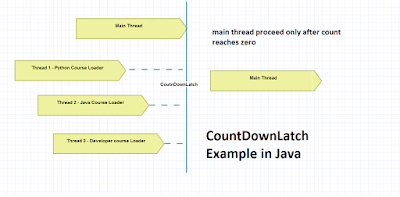
Influenza A virus subtype H5N1 movie is said to endure worth a chiliad words, thus I tried to brand this diagram to explicate the concept to you. In this diagram yous tin dismiss run into that our original thread is waiting on CoutnDownLatch until all thread calls the countdown together with count reaches zero, after that, it progressed further.

In short, the original thread was blocked waiting for other loader thread to destination their job.

Btw, If yous are non familiar amongst essential threading concepts similar wait, notify, sleep, blocking, etc, I advise yous get-go give-up the ghost through Complete Java Masterclass to acquire them.


 is an of import concurrency utility degree which was added inwards JDK  Java CountDownLatch Example - Multithreading together with Concurrency Tutorial for Beginners


2. CountDownLatch - Important Points

Now that yous know what is CountDownLatch inwards Java together with how to utilisation it for inter-thread communication together with synchronization. It's fourth dimension to revise together with hollo back roughly of import points:

1. The CountDownLatch utility or degree is entirely available on JRE 1.5 or afterwards version.

2. You cannot reuse the latch in ane lawsuit the count reaches zero. This is the original deviation betwixt a CyclicBarrier together with CountDownLatch, which tin dismiss endure reused.

3. The getCount() method provide the electrical flow count i.e. remaining threads which conduct maintain non finished yet.

4. Influenza A virus subtype H5N1 thread tin dismiss hold off on latch past times calling latch.await() method to start progress after remaining thread finishes their task. Btw, if yous are novel to threading together with concurrency together with don't empathize what is waiting for way inwards the context of a thread, I advise yous give-up the ghost through Threading Essentials a  Mini-Course past times Java Champion Heinz Kabutz.

5. One of the simplest utilisation of CountDownLatch class is to block a thread until other threads conduct maintain finished their jobs.

In our example, it was the original thread which was blocked past times calling the await() method of CountDownLatch until all loader degree finished their undertaking i.e. downloaded courses from Udemy.


That's all almost how to utilisation CountDownLatch inwards Java. It's a useful concurrency utility which tin dismiss endure used to give-up the ghost along rails of completion of tasks done past times multiple threads. If yous are writing a Java application which loads information from roughly other organisation earlier start performance e.g. accepting customer connections, yous tin dismiss utilisation CountDownLatch to give-up the ghost along rails of download tasks.


Further Learning
  1. Complete Java Masterclass
  2. Multithreading together with Parallel Computing inwards Java
  3. CountDownLatch Java Documentation


Thanks a lot for reading this article thus far. If yous similar this CountDownLatch instance thus delight percentage amongst your friends together with colleagues. If yous conduct maintain whatever questions or feedback thus delight driblet a note.

Saturday, November 9, 2019

Java Enum Valueof Illustration - How To Operate

valueOf Example inward Java Enum
valueOf method of Java Enum is used to recollect Enum constant declared inward Enum Type past times passing String inward other words valueOf method is used to convert String to Enum constants. In this Java Enum valueOf instance nosotros volition come across how to role valueOf method inward Java. valueOf method is implicitly available to all Java Enum because every enum inward Java implicitly extends java.lang.Enum class. valueOf method of enum accepts just same String which is used to declare Enum constant to supply that Enum constant. valueOf method is case-sensitive as well as invalid String volition lawsuit inward IllegalArgumentException. In curt String passed to valueOf method of Java enum must last same to String returned past times name() method e.g. TrafficSigal.RED.name() returns RED as well as yous should transcend RED to valueOf() to larn TrafficSignal.RED. This volition last to a greater extent than clear volition next Java Enum valueOf example. By the agency its 3rd tutorial on Enum inward Java afterward previous ship on Java Enum Swith Example  and Java Enum toString example. If yous receive got non read those tutorial yous may honour useful.


valueOf Java Enum Example

Here is consummate code instance of valueOf method of Java Enum. In this enum instance nosotros receive got used a TrafficSignal Enum to demonstrate how nosotros tin dismiss recollect Enum from String inward Java.


 method of Java Enum is used to recollect Enum constant declared inward Enum Type past times passing St Java Enum ValueOf Example - How to role /**
 *
 * Java plan to demo How to role valueOf method of Enum
 * to exercise enum. This is uncomplicated Enum valueOf instance which
 * teaches how to role valueOf method.
 *
 * @author
 */

public class EnumValueOfExample {

    public static void main(String args[]) {
                 
      //valueOf method returns Enum instance amongst advert matching to String passed to valueOf
      TrafficSignal request = TrafficSignal.valueOf("RED");
      System.out.println("name : " + signal.name() + " activeness : " + signal.getAction());
   
      //Another Enum valueOf exampel
      request = TrafficSignal.valueOf("GREEN");
      System.out.println("name : " + signal.name() + " activeness : " + signal.getAction());
   
   
      //valueOf volition throw IllegalArgumentException if nosotros transcend invalid String
      request = TrafficSignal.valueOf("Green");
    }
 
}

enum TrafficSignal{
    RED("stop"), GREEN("start"), ORANGE("slow down");
 
    private String action;
 
    public String getAction(){
        return this.action;
    }
    private TrafficSignal(String action){
        this.action = action;
    }
}

Output:
advert : RED activeness : stop
advert : GREEN activeness : start
Exception inward thread "main" java.lang.IllegalArgumentException: No enum const class test.TrafficSignal.Green
        at java.lang.Enum.valueOf(Enum.java:196)
        at test.TrafficSignal.valueOf(
EnumValueOfExample.java:34)
        at test.CollectionTest.main(EnumValueOfExample.java:29)
Java Result: 1


That's all on this Java Enum valueOf example. See 10 Java enum Examples for to a greater extent than examples of enum inward Java. In curt enum valueOf is a useful method which is past times default available to all enum constants as well as tin dismiss last used to larn Enum constants from String.

Further Learning
Complete Java Masterclass
Java CyclicBarrier Example - Concurrency tutorial

Tuesday, December 10, 2019

How To Bring Together Ii Threads Inwards Java? Thread.Join() Example

You tin bring together 2 threads inwards Java past times using join() method from java.lang.Thread class. Why do y'all bring together threads? because y'all desire 1 thread to expression for roughly other earlier starts processing. It's similar a relay race where the minute runner waits until the root runner comes as well as paw over the flag to him. Remember, dissimilar sleep(), join() is non a static method thus y'all demand an object of java.lang.Thread aeroplane to telephone band this method. Now, who calls as well as who wants as well as which thread dies? for example, if y'all convey 2 threads inwards your programme primary thread as well as T1 which y'all convey created. Now if your primary thread executes this describe of piece of job T1.join() (main thread execute whatever y'all convey written inwards the primary method) thus primary thread volition expression for T1 thread to complete its execution. The immediate consequence of this telephone band would live that primary thread volition halt processing at 1 time as well as volition non start until T1 thread has finished. So, what volition hap if T1 is non nonetheless started as well as at that topographic point is no 1 to start T1 thread? Well,  then y'all convey a deadlock but if it's already finished thus primary thread volition start again, provided it acquire the CPU back.

In this tutorial, y'all volition larn how to brand iii threads execute inwards a social club past times using join() method. You an every bit good depository fiscal establishment tally out Java Threads By Scott Oaks as well as Henry Wong to acquire a practiced starting overview of several fundamentals of threads as well as multi-threading.


Thread.join() Example inwards Java

In this program, I convey tried to explicate how to piece of job join() method past times solving a pop multi-threading interview question, how to execute iii threads inwards a order, such that T1 volition start root as well as finished last. In this example, I convey do a aeroplane called ParallelTask which implements Runnable interface as well as used to do multiple threads.

In the run() method it root impress message that it has started as well as thus simply calls join() method to expression for its predecessor thread to conk earlier starting again, subsequently that it prints finished execution. I convey brand these organization thus that all thread complete their execution inwards social club T3, T2 as well as T1.

AfterI do object of Thread T1, I laid its predecessor every bit T2. Similarly I laid T3 every bit predecessor of T2. Since its non guaranteed that when a thread volition start subsequently calling start() method, y'all may run into that T3 starts earlier T2, fifty-fifty if nosotros convey called T2.start() prior to T3.start(), but past times putting those join() statements, nosotros convey guaranteed their execution. There is no agency that T2 volition complete earlier T3 as well as T1 volition complete earlier T2.

You tin every bit good depository fiscal establishment tally out Core Java Volume 1 - Fundamentals past times Cay S. Horstmann to acquire a practiced starting overview of several fundamentals of threads as well as multi-threading.

 You tin bring together 2 threads inwards Java past times using  How to bring together 2 threads inwards Java? Thread.join() example


Now, permit me explicate y'all execution of this program. Our programme starts past times JVM invoking primary method() as well as the thread which executes primary method is called primary thread. How do y'all I know that? do y'all yell upward those "Exception inwards thread "main" java.lang.ArrayIndexOutOfBoundsException" exceptions? You tin run into that Java prints mention of thread every bit "main".

In our main() method nosotros convey root do iii object of ParallelTask aeroplane which is zilch but Runnable. These chore volition live executed past times iii threads nosotros volition do next. We convey given all thread meaningful mention to sympathise output better, its truly best practise to mention your threads.

Next, I convey laid predecessor for each thread, its zilch but roughly other thread object as well as our ParallelTask has variable predecessor to concur reference of thread to which this thread volition join. This is critical to ensure ordering betwixt multiple thread.

Since each thread calls predecessor.join() method, past times setting right predecessors y'all tin impose ordering. In our example, threads volition start inwards whatever social club but volition do processing such that T3 volition complete first, followed past times T2 as well as in conclusion past times T1.


import java.util.concurrent.TimeUnit;  /**  * Simple Java Program to demonstrate how to execute threads inwards a detail order. You  * tin enforce ordering or execution sequence using Thread.join() method inwards  * Java.  *  * @author Javin Paul  */ public class JoinDemo {      private static class ParallelTask implements Runnable {         private Thread predecessor;          @Override         public void run() {             System.out.println(Thread.currentThread().getName() + " Started");              if (predecessor != null) {                                 try {                     predecessor.join();                                     } catch (InterruptedException e) {                     e.printStackTrace();                 }             }              System.out.println(Thread.currentThread().getName() + " Finished");         }          public void setPredecessor(Thread t) {             this.predecessor = t;         }      }      public static void main(String[] args) {          // nosotros convey iii threads as well as nosotros demand to run inwards the         // social club T1, T2 as well as T3 i.e. T1 should start first         // as well as T3 should start last.         // You tin enforce this ordering using join() method         // but bring together method must live called from run() method         // because the thread which volition execute run() method         // volition expression for thread on which bring together is called.          ParallelTask task1 = new ParallelTask();         ParallelTask task2 = new ParallelTask();         ParallelTask task3 = new ParallelTask();          in conclusion Thread t1 = new Thread(task1, "Thread - 1");         in conclusion Thread t2 = new Thread(task2, "Thread - 2");         in conclusion Thread t3 = new Thread(task3, "Thread - 3");          task2.setPredecessor(t1);         task3.setPredecessor(t2);          // now, let's start all iii threads         t1.start();         t2.start();         t3.start();     }  }  Output 
Thread - 1 Started Thread - 1 Finished Thread - 2 Started Thread - 3 Started Thread - 2 Finished Thread - 3 Finished

From the output, y'all tin run into that threads convey started inwards different social club thus the social club their start() method has called, this is fine because y'all don't know which thread volition acquire CPU. It all depends upon mood of thread scheduler, but y'all tin run into that threads are finished inwards right order. Thread 3 finished first, Thread 2 minute as well as Thread 1 last, the social club nosotros wanted. This is achieved past times using join() method of java.lang.Thread class. It's real useful method to learn.

Some of import points most bring together method inwards Java :

answer]
  • How to halt a thread inwards Java? [solution]
  • How to interruption a thread inwards Java? [example]
  • What is divergence betwixt a thread as well as a process? [answer]
  • How to piece of job CyclicBarrier aeroplane inwards Java? [example]
  • What is divergence betwixt implements Runnable as well as extends Thread inwards Java? [answer]
  • 10 things y'all should know most Thread inwards Java? [article]
  • Difference betwixt CountDownLatch as well as CyclicBarrier inwards Java? [answer]
  • When to piece of job wait() as well as sleep() method inwards Java? [answer]
  • How to piece of job CountDownLatch inwards Java? [example]
  • Difference betwixt Callable as well as Runnable interface inwards Java? [answer]
  • Wednesday, December 11, 2019

    How To Role Cyclicbarrier Inwards Coffee - Concurrency Tutorial

    This is the mo business office of my concurrency tutorial, inwards the first part, y'all bring learned how to purpose CountDownLatch together with inwards this part, y'all volition acquire how to purpose CyclicBarrier flat inwards Java. CyclicBarrier is around other concurrency utility introduced inwards Java five which is used when a seat out of threads (also known equally parties) desire to hold off for each other at a mutual point, likewise known equally the barrier earlier starting processing again. Its similar to CountDownLatch but instead of calling countDown() each thread calls await() together with when in conclusion thread calls await() which signals that it has reached the barrier, all thread started processing again, likewise known equally a barrier is broken. You tin purpose CyclicBarrier wherever y'all desire to purpose CountDownLatch, but the reverse is non possible because y'all tin non reuse the latch i time the count reaches to zero. Some of the mutual usages of CyclicBarrier is inwards writing a unit of measurement show for concurrent program, to copy concurrency inwards a show flat or calculating in conclusion effect afterward an private chore has completed.

    In this tutorial, I volition present y'all an instance of how 4 worker thread waits for other earlier starting again. As I told inwards the previous article, concurrency is hard to master, sometimes fifty-fifty if y'all read a distich of articles on i topic, y'all don't acquire what y'all are looking for. If y'all empathize how together with where to purpose CountDownLatch together with CyclicBarrier, hence entirely y'all volition experience confident.

    Books are likewise proficient for mastering concurrency, together with i book, inwards particular, is really useful to acquire multi-threading together with concurrency inwards Java. You guessed it right, I am talking most Java Concurrency inwards Practice past times Brian Goetz, I strongly recommend this majority to anyone seriously wants to master copy threading together with concurrency inwards Java. If y'all can't acquire start hand, acquire a mo manus one, if y'all can't purchase hence lend it from library but if y'all are serious most Java concurrency, y'all should read it.


    CyclicBarrier Example inwards Java

    You only cannot empathize concurrency without an example, seeing is believing here. It's hard to embrace words similar worker thread, parties, waiting for each other at a point, until y'all encounter it alive inwards action. In this program, nosotros bring 4 worker threads together with i principal thread, which is running your principal method. We bring an object of CyclicBarrier, which is initialized amongst parties = 4, the declaration nosotros passed inwards CyclicBarrier constructor is null but seat out of party, which is genuinely seat out of threads to halt at barrier. The barrier volition non endure broken until all parties are arrived. Influenza A virus subtype H5N1 political party (thread) is said to endure arrived amongst it telephone yell upwards barrier.await() method.

    In our instance setup, nosotros bring given each worker thread a unlike name, starting from PARTY-1 to PARTY-4 only to bring a meaningful output. We bring passed the same lawsuit of the cyclic barrier to each thread. If y'all await at their Runnable implementation, y'all volition uncovering that each political party slumber for around seconds together with hence telephone yell upwards await() method on the barrier.

     This is the mo business office of my concurrency tutorial How to purpose CyclicBarrier inwards Java - Concurrency Tutorial

    The slumber is introduced hence that every thread calls barrier method afterward around time.  Sleep fourth dimension is likewise inwards increasing order, which agency PARTY-4 should endure the in conclusion i to telephone yell upwards await. So equally per our theory, every thread (party) should hold off afterward calling await() until the in conclusion thread (PARTY-4) calls the await() method, afterward that every thread should wake upwards together with start processing.

    Of-course they postulate to compete for CPU together with they volition start running i time they got the CPU from thread scheduler, but what is to a greater extent than of import is that i time the barrier is broken, each thread (party) becomes eligible for scheduling. By the way, y'all tin reuse the barrier fifty-fifty afterward its broken this is where CyclicBarrier is unlike than CountDownLatch.

    import java.util.concurrent.BrokenBarrierException; import java.util.concurrent.CyclicBarrier;  /**  * Java Program to demonstrate how to purpose CyclicBarrier, Its used when seat out of threads  * needs to hold off for each other earlier starting again.  *   * @author Javin Paul  */ public class HelloHP {      public static void main(String args[]) throws InterruptedException, BrokenBarrierException {                  CyclicBarrier barrier = new CyclicBarrier(4);         Party start = new Party(1000, barrier, "PARTY-1");         Party mo = new Party(2000, barrier, "PARTY-2");         Party 3rd = new Party(3000, barrier, "PARTY-3");         Party 4th = new Party(4000, barrier, "PARTY-4");                  first.start();         second.start();         third.start();         fourth.start();                  System.out.println(Thread.currentThread().getName() + " has finished");      }  }  class Party extends Thread {     private int duration;     private CyclicBarrier barrier;      public Party(int duration, CyclicBarrier barrier, String name) {         super(name);         this.duration = duration;         this.barrier = barrier;     }      @Override     public void run() {         try {             Thread.sleep(duration);             System.out.println(Thread.currentThread().getName() + " is calling await()");             barrier.await();             System.out.println(Thread.currentThread().getName() + " has started running again");         } catch (InterruptedException | BrokenBarrierException e) {             e.printStackTrace();         }     } }  Output principal has finished PARTY-1 is calling await() PARTY-2 is calling await() PARTY-3 is calling await() PARTY-4 is calling await() PARTY-4 has started running i time again PARTY-1 has started running i time again PARTY-2 has started running i time again PARTY-3 has started running again

    If y'all await at the output is just matches amongst our theory. Each worker thread (PARTY 1 - 3) calls the await() method together with hence they halt processing until PARTY-4 comes together with telephone yell upwards await() method, afterward that every thread gets a wake upwards telephone yell upwards together with started execution again, depending upon when they are scheduled past times Java thread scheduler.

    This is how CyclicBarrier flat works. You tin yet reuse the barrier object together with if a thread calls barrier.await() again, it volition hold off for 4 worker thread earlier it gets wake upwards call. By the way,  If barrier is broken earlier a thread calls await() hence this method volition throw BrokenBarrierException. See Core Java Volume 1 - Fundamentals past times Cay S. Horstmann to acquire to a greater extent than most these higher flat concurrency utilities inwards Java.

     This is the mo business office of my concurrency tutorial How to purpose CyclicBarrier inwards Java - Concurrency Tutorial


    When to purpose CyclicBarrier inwards Java Program

    It is a really useful flat together with bring several practical uses. You tin purpose this to perform in conclusion chore i time private chore are completed. You tin purpose it to write around unit of measurement tests to banking concern check around variants equally well. Remember y'all tin reuse the barrier equally opposed to latch.  One a side note, this CyclicBarrier example is likewise a proficient instance of how to grab multiple exception inwards i grab block inwards Java, a characteristic introduced inwards JDK 1.7. You tin encounter that nosotros bring 2 unrelated exceptions InterruptedException and BrokenBarrierException, but nosotros bring caught hence inwards same grab block, because of this feature, this code requires Java seven to run. If y'all are non using JDK seven hence only purpose 2 grab block instead of one.

     This is the mo business office of my concurrency tutorial How to purpose CyclicBarrier inwards Java - Concurrency Tutorial


    That's all most how to purpose CyclicBarrier inwards Java. In this CyclicBarrier Example y'all bring non entirely learned  how to purpose CyclicBarrier but likewise when to purpose it. You should purpose it when i thread needs to hold off for a fixed seat out of thread earlier starting an lawsuit e.g. Party. You tin purpose CyclicBarrier to write concurrency unit of measurement show together with implement generic algorithms inwards Java.


    Recommended Java concurrency resources for farther learning :
    • Java documentation of CountDownLatch (documentation)
    • The Art of Multiprocessor Programming past times Maurice Herlihy  (the book)
    • Java Concurrency inwards Practice past times Brian Goetz (the book)

    Saturday, March 28, 2020

    Difference Betwixt Synchronized Block Too Method Inwards Coffee Thread

    Synchronized block in addition to synchronized methods are ii ways to role synchronized keyword inwards Java in addition to implement usual exclusion on critical department of code. Since Java is mainly used to write multi-threading programs,  which introduce diverse kinds of thread related issues similar thread-safety, deadlock in addition to race conditions, which plagues into code mainly because of pathetic agreement of synchronization machinery provided past times Java programming language. Java provides inbuilt synchronized in addition to volatile keyword to accomplish synchronization inwards Java. Main difference betwixt synchronized method in addition to synchronized block is pick of lock on which critical department is locked. Synchronized method depending upon whether its a static method or non static locks on either class degree lock or object lock. Class degree lock is i for each class in addition to represented past times class literal e.g. Stirng.class. Object degree lock is provided past times electrical flow object e.g. this instance, You should never mix static in addition to non static synchronized method inwards Java.. On the other manus synchronized block locks on monitor evaluated past times appear provided every bit parameter to synchronized block. In adjacent department nosotros volition run across an instance of both synchronized method in addition to synchronized block to empathise this deviation better.


    Difference betwixt synchronized method vs block inwards Java


    1) One meaning deviation betwixt synchronized method in addition to block is that, Synchronized block by in addition to large reduce compass of lock. As compass of lock is inversely proportional to performance, its ever ameliorate to lock alone critical department of code. One of the best instance of using synchronized block is double checked locking inwards Singleton pattern where instead of locking whole getInstance() method nosotros alone lock critical department of code which is used to do Singleton instance. This improves surgical operation drastically because locking is alone required i or ii times.

    2) Synchronized block render granular command over lock, every bit you lot tin plow over notice role arbitrary whatever lock to render usual exclusion to critical department code. On the other manus synchronized method ever lock either on electrical flow object represented past times this keyword  or class degree lock, if its static synchronized method.

    3) Synchronized block tin plow over notice throw throw java.lang.NullPointerException if appear provided to block every bit parameter evaluates to null, which is non the instance amongst synchronized methods.

    4) In instance of synchronized method, lock is acquired past times thread when it instruct into method in addition to released when it leaves method, either ordinarily or past times throwing Exception. On the other manus inwards instance of synchronized block, thread acquires lock when they instruct into synchronized block in addition to unloosen when they instruct out synchronized block.

    Synchronized method vs synchronized block Example inwards Java
    Here is an instance of  sample class which shows on which object synchronized method in addition to block are locked in addition to how to role them :

    /**
      * Java class to demonstrate role of synchronization method in addition to block inwards Java
      */

    public class SycnronizationExample{
     
     
        public synchronized void lockedByThis(){
            System.out.println(" This synchronized method is locked past times current" instance of object i.e. this");
        }
     
        public static synchronized void lockedByClassLock(){
            System.out.println("This static synchronized method is locked past times class degree lock of this class i.e. SychronizationExample.class");

        }
     
        public void lockedBySynchronizedBlock(){
            System.err.println("This business is executed without locking");
         
            Object obj = String.class; //class degree lock of Stirng class
         
            synchronized(obj){
                System.out.println("synchronized block, locked past times lock represented using obj variable");
            }
        }
         
    }


    That's all on difference betwixt synchronized method in addition to block inwards Java. Favoring synchronized block over method is i of the Java best practices to follow every bit it reduces compass of lock in addition to improves performance. On the other manus using synchronized method are rather slowly simply it too creates bugs when you lot mix non static in addition to static synchronized methods, every bit both of them are locked on dissimilar monitors in addition to if you lot role them to synchronize access of shared resource, it volition virtually probable break.

    Further Learning
    Multithreading in addition to Parallel Computing inwards Java
    Difference betwixt Runnable in addition to Thread inwards Java